Does Car Insurance Cover Towing?
Towing can be covered by car insurance if you carry the additional coverage. Learn about the benefits of having the coverage, towing after an accident and more.

by COUNTRY Financial
A car insurance deductible is the amount you pay before your insurance coverage applies. For most drivers, the $500 vs $1,000 deductible choice is the most common and the most misunderstood.
This guide breaks down how deductibles work, how much you can realistically save, and how to choose a deductible that protects your finances instead of creating surprises after a claim.
Find out more about car insurance
Find out more about car insurance
A car insurance deductible is your share of the cost after a covered claim. It applies to certain coverages and directly affects how quickly repairs can move forward.
A deductible typically applies when you file a claim under collision coverage or comprehensive coverage.
Here is what usually happens:
Damage occurs from a covered event.
Repairs are estimated.
You pay the deductible.
Insurance pays the remaining covered amount.
If your deductible is $1,000, you must cover that amount before repairs are completed.
Deductibles generally do not apply to:
Liability coverage for injuries or damage you cause
Claims where the other driver is at fault and insured
Certain no fault situations, depending on state rules
This distinction is important when comparing deductible options.
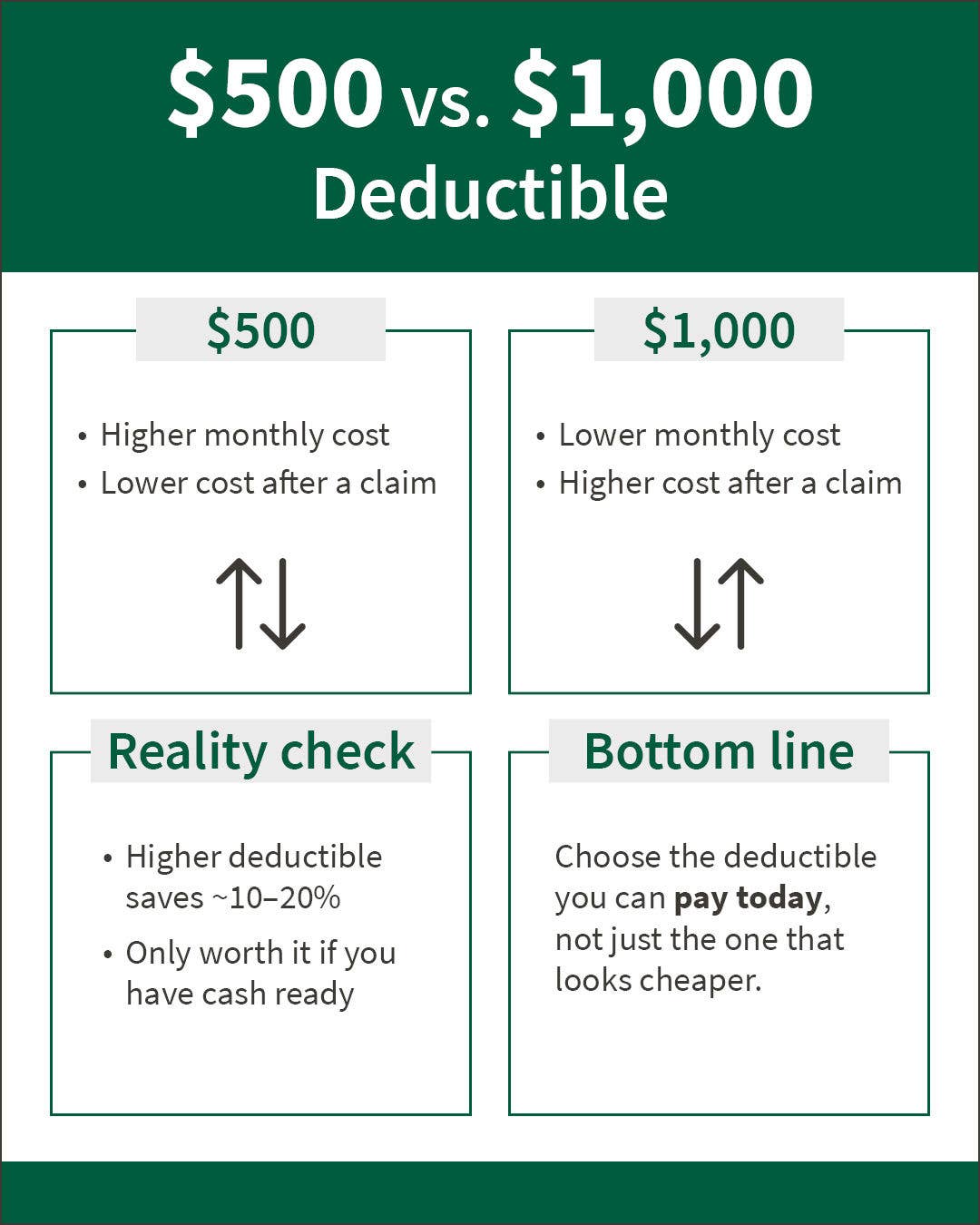
The difference between a $500 and $1,000 deductible shows up in both monthly cost and time.
| Factor | $500 Deductible | $1,000 Deductible |
|---|---|---|
| Monthly premium | Higher | Lower |
| Out of pocket after claim | Lower | Higher |
| Cash flow impact | Easier to manage | Requires more savings |
| Best fit | Limited savings or higher claim risk | Strong savings and low claim risk |
Higher deductibles shift more risk to the driver. Insurers price that reduced exposure with lower premiums. The tradeoff is that you carry more financial responsibility when something goes wrong.
Premium savings from a higher deductible are real, but often smaller than drivers expect.
For many drivers, moving from a $500 to $1,000 deductible may reduce premiums by 10 to 20 percent. The exact amount depends on driving record, vehicle type, and location.
Savings vary widely, which is why deductible decisions should not rely on averages alone.
If a $1,000 deductible saves $15 per month, that is $180 per year.
It would take nearly three years of savings to offset the extra $500 you would owe after a claim. If you file a claim sooner, the higher deductible may cost more than it saves.
Your deductible should align with the cash you can access quickly.
Use this rule:
Choose a deductible you can pay without borrowing.
If paying the deductible would require a credit card or loan, it is too high.
Understanding how deductibles work helps avoid repair delays after an accident.
A driver with $600 in savings may struggle with a $1,000 deductible.
A driver with $3,000 in savings can absorb either option comfortably.
Strong savings provide flexibility without stress.
Claim history matters more than monthly price when choosing a deductible.
Drivers with clean records and low mileage often benefit more from higher deductibles. Premium savings compound over time when claims are rare.
Frequent driving or recent claims increase the chance of using coverage. A $500 deductible can reduce financial shocks when claims happen more often.
Your deductible should make sense relative to your car’s value.
Higher repair costs make deductible choice more impactful. Lenders often require collision and comprehensive coverage, which means deductibles will come into play after many claims.
If a $1,000 deductible approaches the car’s value, paying for coverage may no longer make sense. Some drivers lower deductibles or drop certain coverages instead.
Some drivers choose different deductibles for different risks.
Comprehensive claims such as theft or weather damage often occur more frequently than collision claims. A lower comprehensive deductible can reduce disruption in these scenarios.
Areas with high weather risk
Regions with theft or animal collision exposure
Drivers seeking balanced protection
Deductible choices are not permanent.
Review and adjust deductibles after:
Building stronger savings
Paying off a vehicle loan
Experiencing premium increases
Changes in driving habits or location
Regular reviews keep coverage aligned with your financial position.
Use this checklist to finalize your decision.
Emergency fund size
Vehicle value
Claim history
Monthly budget flexibility
Personal risk tolerance
This checklist helps you decide based on control, not guesswork.
Choosing between a $500 and $1,000 deductible comes down to stability, not savings alone. The right deductible supports quick repairs, predictable cash flow, and peace of mind after an accident. Revisit the decision as your savings and driving profile change.
COUNTRY Financial auto insurance helps drivers align deductibles and coverage with real world risk and long term affordability.
It may be too high if you cannot pay it from savings without financial strain.
For drivers with limited savings or higher claim risk, the added premium may be worth the protection.
Yes. Most insurers allow deductible changes at renewal or during the policy term.
No. Deductibles apply to certain coverages like collision and comprehensive, not liability.
Published 3-5-2026
Updated 5-6-26
Towing can be covered by car insurance if you carry the additional coverage. Learn about the benefits of having the coverage, towing after an accident and more.

What is car insurance? We’ll explain all the types of coverage to help you understand how car insurance works so you can find the protection you need.

Regular auto maintenance repairs are not typically covered by car insurance. Learn about what types of repairs would be covered by your insurance policy.
Start a quote or call us at 866-COUNTRY (866-268-6879). Find out more about car insurance.
Contact your rep or call us at 866-COUNTRY (866-268-6879). Find out more about car insurance.
COUNTRY Financial® is a family of affiliated companies (collectively, COUNTRY) located in Bloomington, IL. Learn more about who we are.
Auto insurance policies issued by COUNTRY Mutual Insurance Company®, COUNTRY Preferred Insurance Company® and COUNTRY Casualty Insurance Company®, Bloomington, IL.