Market and Economic Outlook - Released 12/31/25
Key takeaways:
- While uncertainty has persisted throughout the year which aided in falling confidence, the consumer continued to spend through it all and markets gave us another strong year of returns.
- Despite recent years of underperformance from small and medium size market capitalization stocks versus large cap stocks, a strong earnings growth profile and more attractive valuations have us preferring small and mid-cap companies versus large cap companies going into 2026.
- Investors are not being adequately rewarded for taking additional risk in bonds. We maintain a core allocation to high-quality fixed income while limiting exposure to lower quality areas.
2025 reminded us that “typical” in markets often means anything but predictable. The year began calmly, but spring brought historic volatility driven by uncertainty around U.S. trade policy. Investors questioned the traditional safe-haven role of U.S. Treasuries, and we saw a rotation into non-U.S. assets and currencies.
Fortunately, fears of severe tariffs eased, inflation began to moderate, and optimism returned, fueled by massive investments in artificial intelligence technology. Midyear, the longest government shutdown in history disrupted economic data reporting, adding to uncertainty. Yet, the year closed on a calmer note as markets stabilized, and confidence improved.
"If you aren't willing to own a stock for 10 years, don't even think about owning it for 10 minutes." Warren Buffett's timeless advice reminds us that patience and discipline are key to building lasting wealth in any market environment. This long-term perspective is especially relevant today, as we are experiencing a period of immense innovation. From breakthroughs in innovative drugs that are redefining treatment for chronic conditions and even targeting healthy aging to the productivity gains fueled by artificial intelligence, the “good old days” are happening now. We believe these themes offer a wide range of investment opportunities that will define and shape the future of the global economy.
As we move into 2026, we’re keeping an eye on how expensive the stock market looks, especially the biggest companies in major indexes like the S&P 500. The economy and company profits still appear healthy, but because stock prices are starting from higher levels, future returns may be lower than what we’ve seen in the past.
In this environment, we have a slight preference for equities over bonds within multi-asset portfolios. However, given current valuations, selectivity is key. We favor mid and small-cap stocks relative to large cap stocks, where opportunities may be more compelling. At the same time, high quality bonds offer attractive yields and serve as a strategic complement to stocks for those focused on risk management.
Uncertainty persists as year closes
We began the year with uncertainty surrounding tariff announcement, and we will do the same on the way out but with different drivers. The fourth quarter commenced with the government shutdown which ended up lasting a total of 43 days, which is the longest government shutdown in history. While the shutdown officially ended on November 12, many of the economic data reports were delayed until after the Federal Open Market Committee (FOMC) meeting which left the investment community and the Federal Reserve to make their own assumptions on where inflation and the labor market stood heading into the final meeting of the year. Ultimately, the committee decided that the risk to employment on the downside was greater than that of inflation to the upside, and with that cut the Fed funds rate to a range of 3.50% to 3.75%.
Once the government reopened, we began to receive the backlog of releases. Inflation came in better than expected with both headline and core Consumer Price Index softening to a 2.7% and 2.6% yearly increase, respectively (though some economists have cited the government shutdown as reasoning for inaccurate data included in the release). The labor market, on the other hand, has cooled since the beginning of the year with payrolls showing a loss of 105,000 jobs in October followed by a gain of 64,000 in November. Job losses were driven by the Federal Government, which shed 162,000 jobs in October and another 6,000 in November. Private payrolls, conversely, have held up relatively well averaging 75,000 new jobs over the past three months. The unemployment rate jumped to 4.6% to end the year.
Shaking off the news
Consumer confidence continued to be weak ending the year with five consecutive months of declines in the index. Declines in consumer confidence this year, however, have not stopped the consumer from spending. Gross Domestic Product (GDP) increased by a robust 4.3% seasonally adjusted annual rate in the third quarter driven by a 3.5% increase in consumer purchases of goods and services. Retail sales, also affected by the shutdown, slowed in October showing flat sales over the month, though excluding autos and fuel, sales increased by 0.5%.
Despite the headlines, the market continued to march higher in the quarter led by international shares while the U.S. market in total returned 2.4%. We ended the year with new all-time closing highs for the S&P 500 (December 24). The U.S. market produced a third consecutive year of double-digit returns, up 17.9%, while international developed markets posted a total return of 31.9% which is their best performance since 2009.
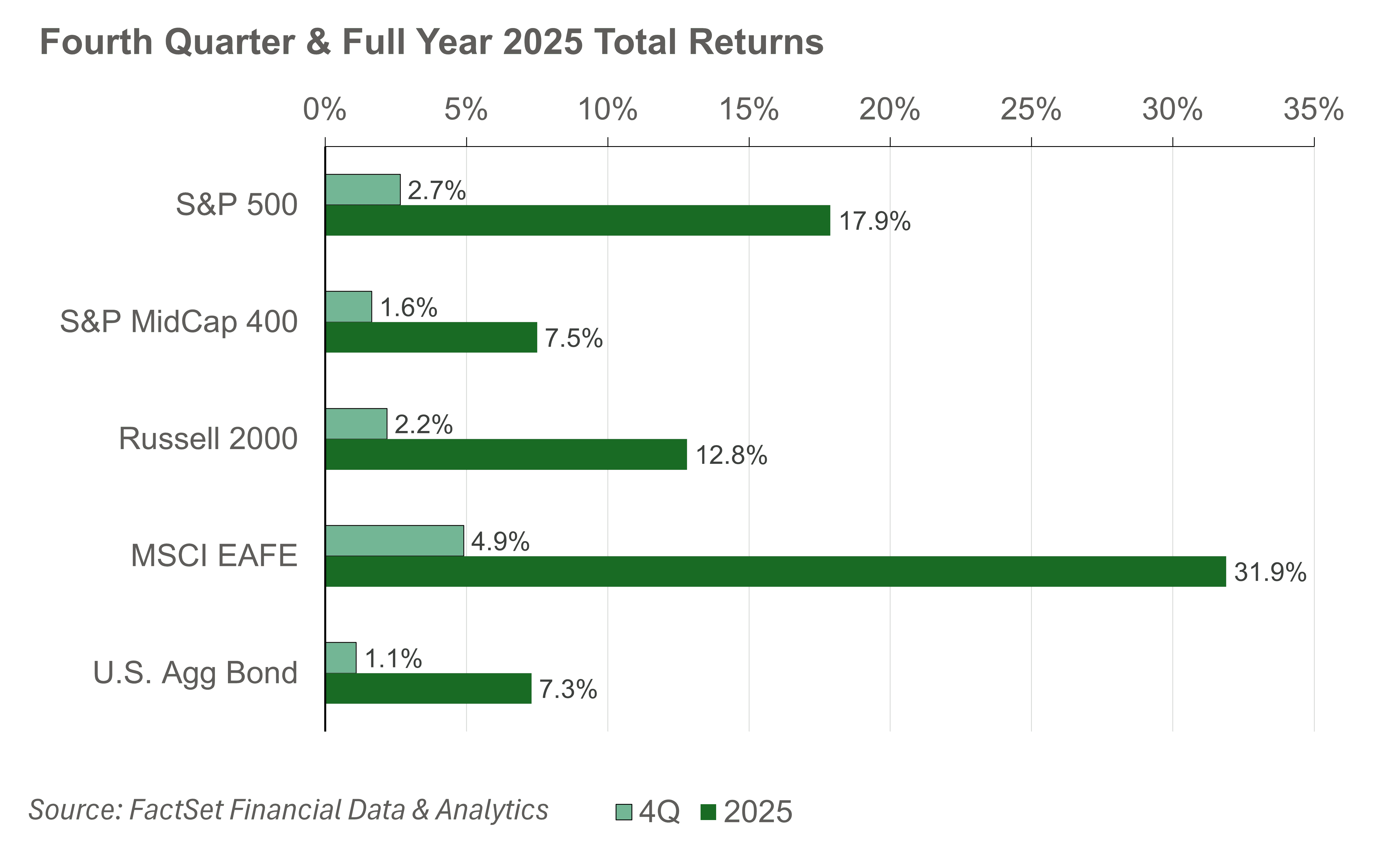 Figure 1
As we head into 2026, we remain constructive on both the economy and the stock market. That said, we do not expect stocks to give us the types of returns we have seen over the last three years. With valuations remaining somewhat elevated, we expect returns to be closer to the historical averages. We received three rate cuts by the Fed this year, and through next year we would expect to get another one or possibly two. Those may not come at the beginning of the year as the market is expecting the Fed to take a pause on any rate movements for the first meeting or two.
Reflections on stocks
Major stock market indices finished 2025 on steady footing with the fourth quarter supporting strong returns across many different asset classes. As we move into a new calendar year, it is helpful to reflect on where equity markets were in 2025 while setting the stage for our outlook on various asset classes within stocks going forward.
International stocks shined after trailing U.S. peers in recent years by a substantial margin. While outperforming on the backdrop of a weaker dollar in 2025, international stocks still trail their U.S. counterparts significantly over a 10-year period having underperformed by nearly 164% since the end of 2015 (Figure 2). Currently, due to sector composition differences and, in our view, a lack of significant catalysts that would support persistent international outperformance versus U.S. stocks, we maintain a neutral outlook between domiciles. We continue to believe a meaningful allocation to international stocks that aligns with investor risk tolerance in a diversified portfolio makes sense across market cycles over the long term.
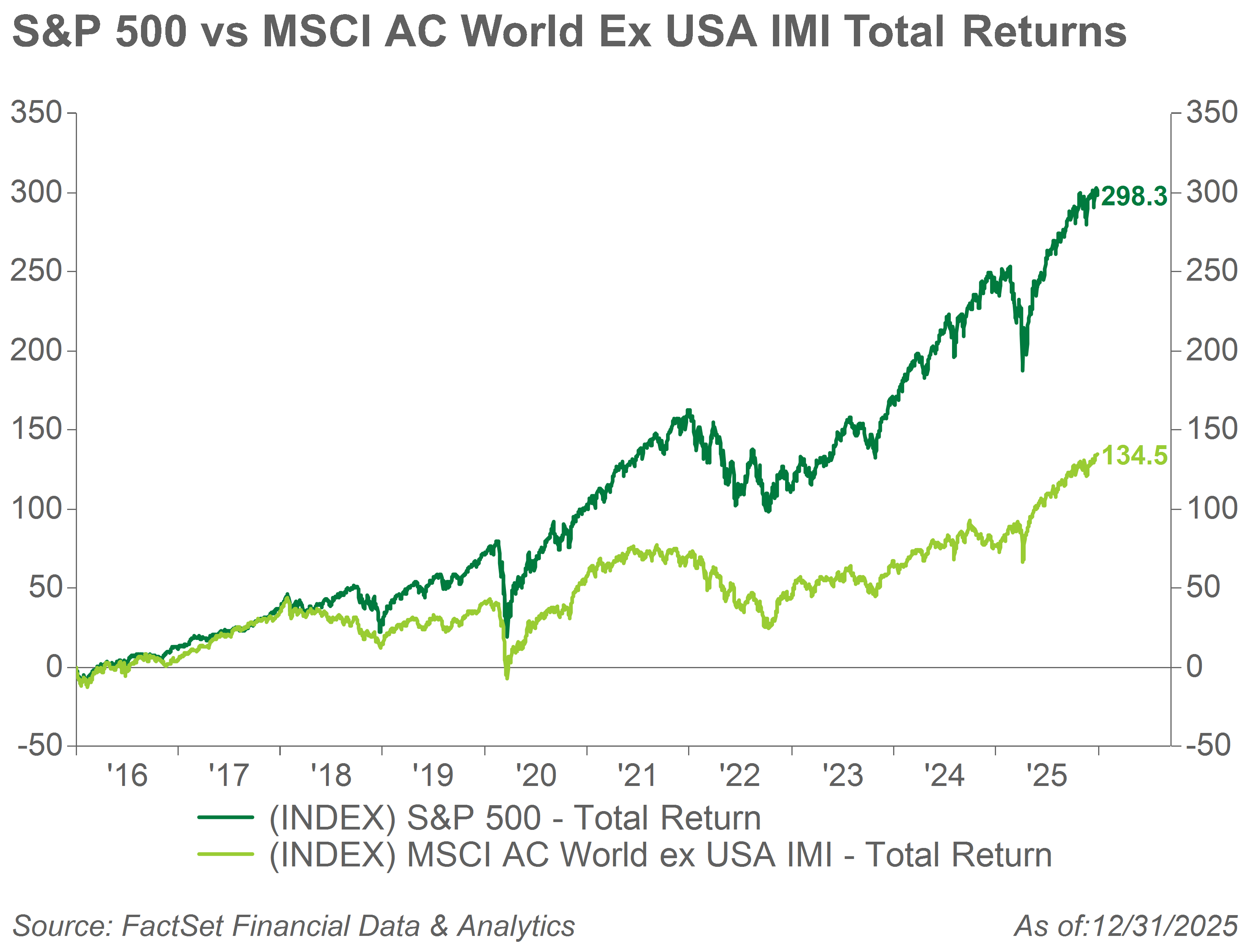 Figure 2
In 2025, the S&P 500 continued what has been a strong 3-year run with annualized returns of 23% over this time frame. While strong earnings growth has supported this rally, particularly earnings growth for companies exposed to Artificial Intelligence, it has also stretched the benchmark’s valuation on a next twelve-month price-to-earnings ratio (NTM PE) basis to near 20-year highs. This results in the S&P 500 NTM PE exceeding the S&P Small Cap 600 Index by nearly 50% over this time frame, which is a two standard deviation premium to small cap stocks, which may suggest rich valuations in large cap relative to small cap (Figure 3). Until some recent strength in the second half of 2025, small and mid-size company peers have not kept up with the pace of share price and earnings growth relative to large cap in recent years. We are beginning to see signs of this trend changing as 2026 consensus earnings estimates for both the S&P Small-Cap 600 and the S&P Mid-Cap 400 indexes are slated to exceed that of the S&P 500 according to FactSet data. Given a strong earnings growth profile and more attractive valuations, we prefer small and mid-size market capitalization companies versus large cap heading into 2026.
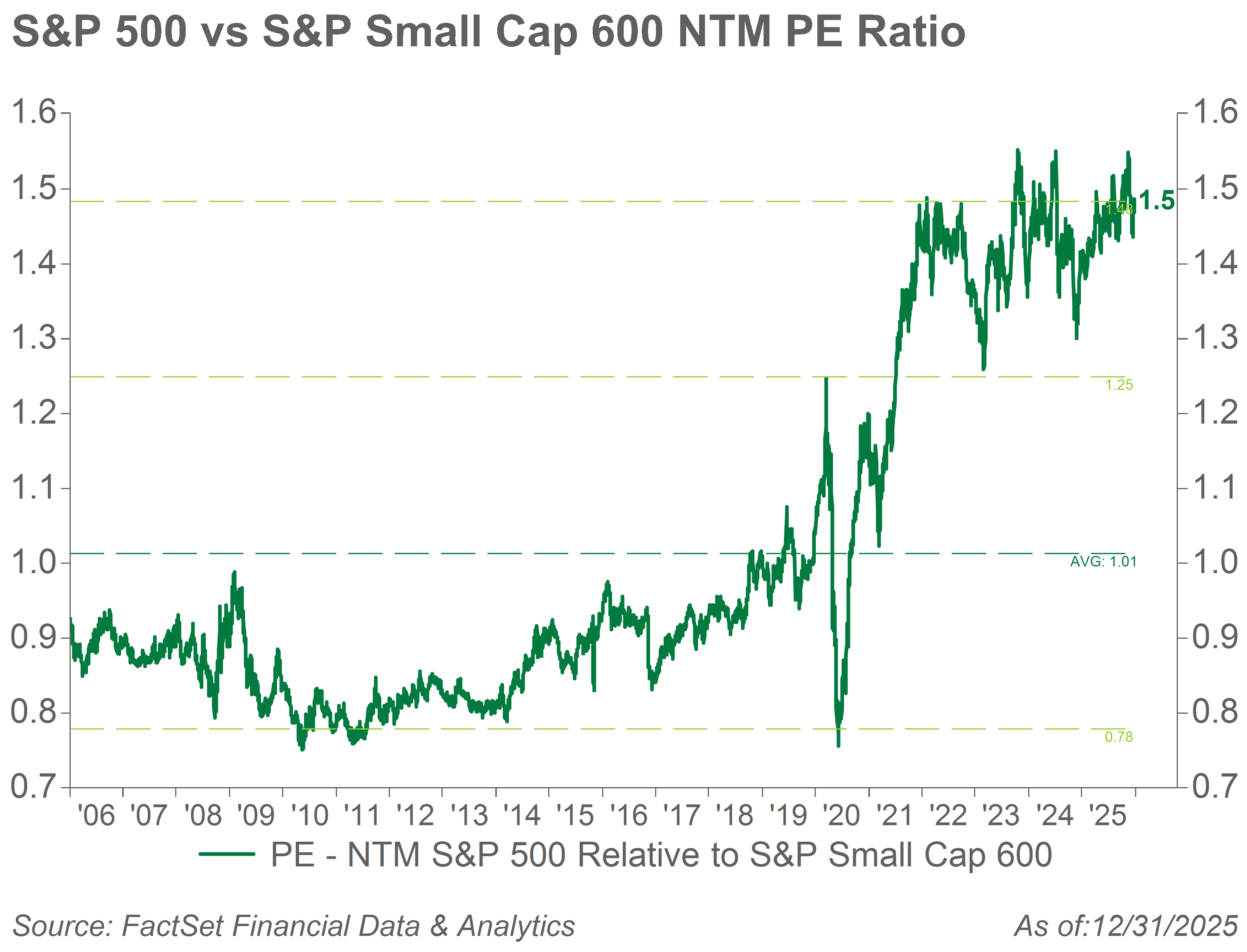 Figure 3
A look at alternative asset classes
In the fourth quarter, headlines were dominated by volatility in the precious metals market and cryptocurrency asset classes. Silver was up over 23% in December alone after an already strong 11 months previously, which contributed to the metal returning 141% for the year. Gold shined throughout the year as the metal returned 65% while hitting record highs. After a strong rally through October, the cryptocurrency, Bitcoin, fell -23% in the fourth quarter and ended 2025 down -6.5% for the year (Figure 4). There are a number of factors that led to the price action we have seen throughout the year in these alternative asset classes, but through the lens of our asset allocation framework, our primary takeaway is that we continue to maintain a preference for cash flow generating assets like stocks and bonds that are aligned with investment goals and a structured financial plan.
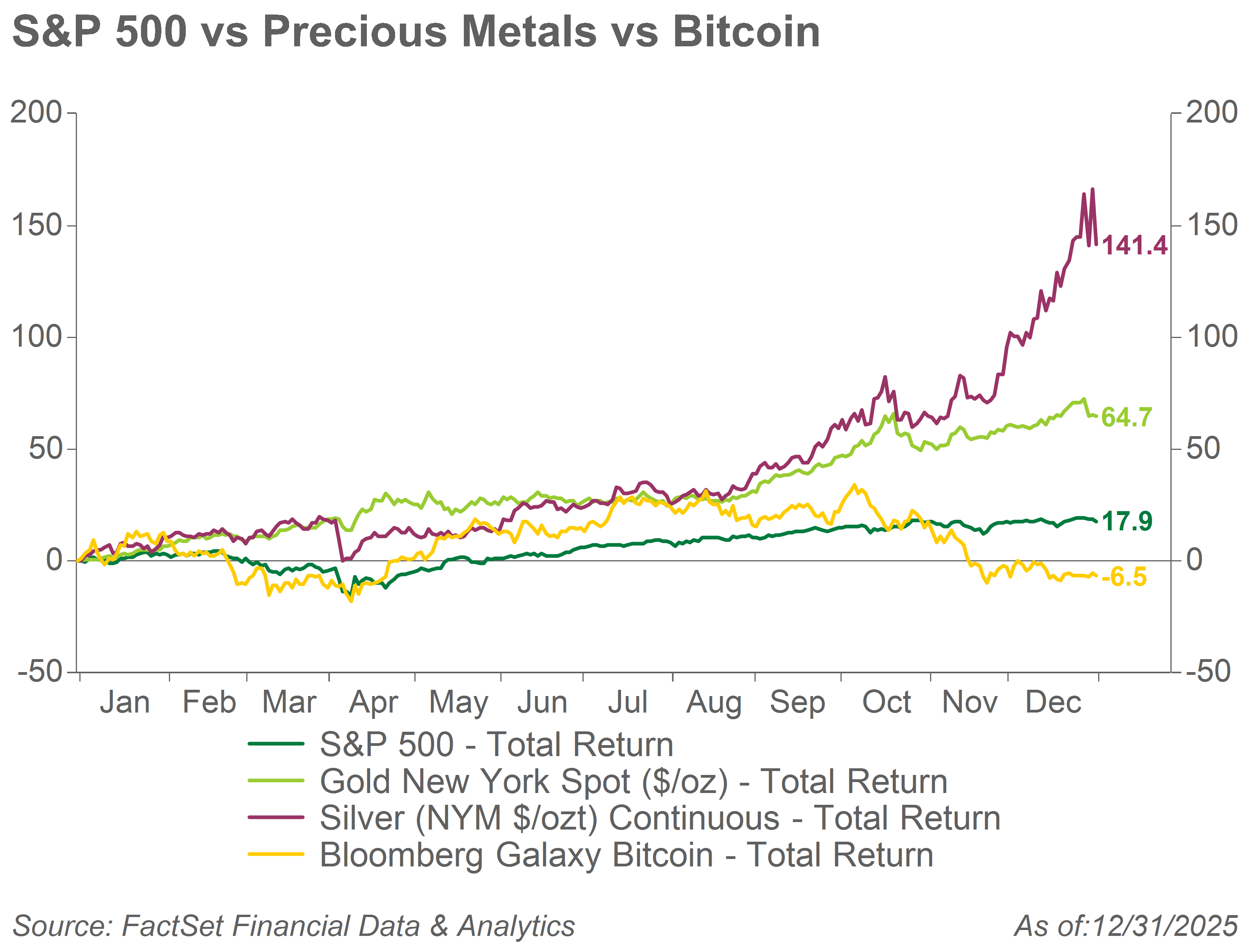 Figure 4
Bond bounce
2025 marked a turning point for U.S. bonds. The Bloomberg U.S. Aggregate Bond Index advanced 7.3%, its strongest annual gain since 2020, supported by Federal Reserve rate cuts and easing inflation pressures. While Treasury yields ended the year lower, providing a tailwind for bond returns, the path was volatile at times. Rates spiked sharply in the spring amid trade and policy uncertainty, before retreating and oscillating within a range-bound pattern throughout the second half. By December, yields had declined from their highs, reinforcing the positive performance for fixed income (Figure 5).
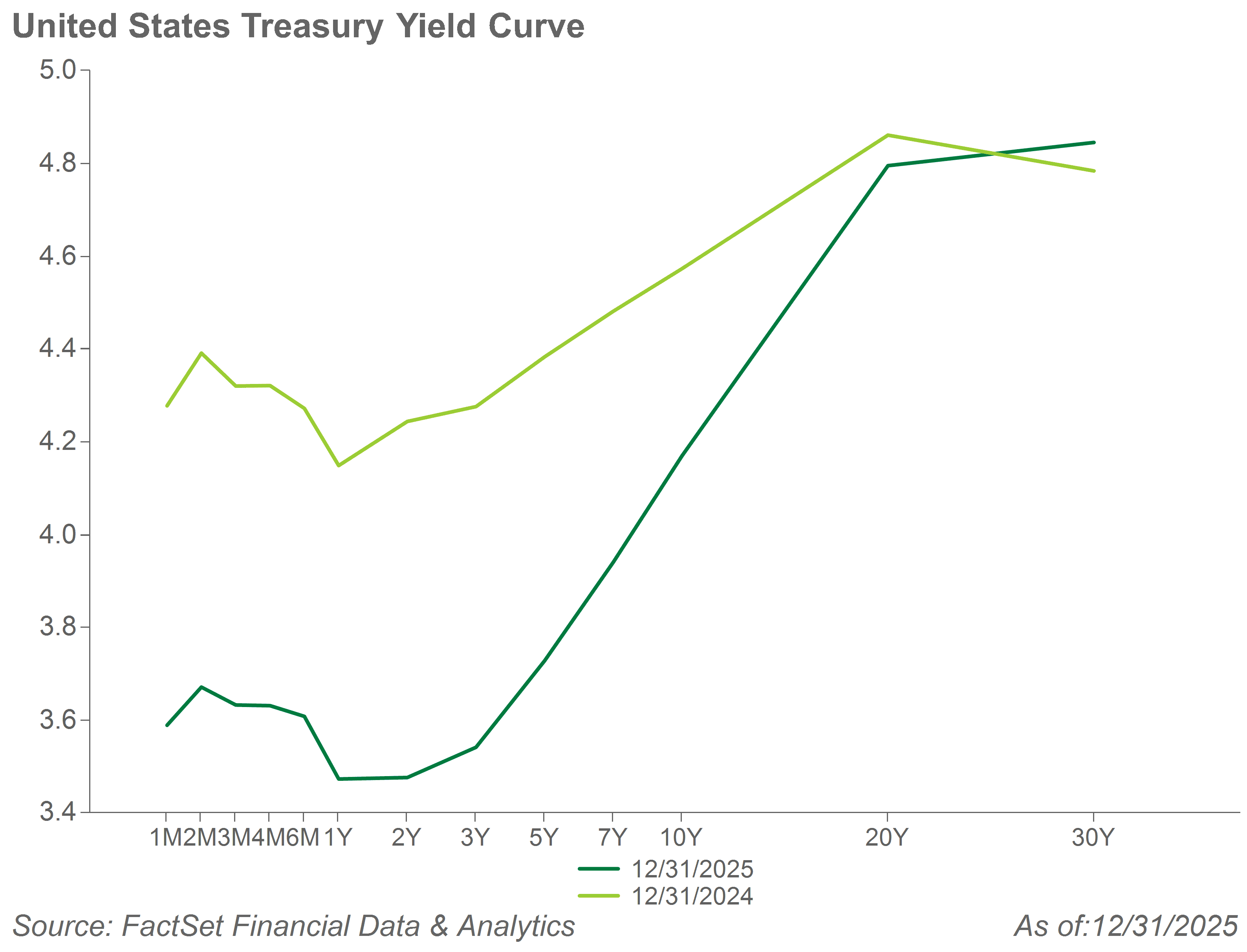 Figure 5
Quality over risk
Credit spreads, or the extra yield bonds offer over comparable U.S. Treasuries to compensate for risk, tightened to multi-decade lows earlier this year, supported by strong corporate fundamentals and demand for income. Recently, spreads have widened slightly, signaling caution amid renewed market volatility. Despite this, most fixed income sectors remain near historically tight levels, meaning investors are not being adequately rewarded for taking additional credit risk. Given this backdrop, our recommendation is to maintain a core allocation to high-quality fixed income while limiting exposure to lower quality areas.
Privately issued bonds—loans made directly to companies outside public markets—have attracted attention for their higher yields, which reflect greater default risk and lower liquidity. While most of these remain outside the traditional banking system, structural weaknesses such as weaker loan protections and limited transparency could create stress if economic conditions worsen. For most investors, focusing on high-quality bonds and avoiding overly complex bond structures remains the prudent approach.
The outlook for bonds in 2026 is constructive but nuanced. Following the Federal Reserve’s December meeting, policymakers signaled that interest rate cuts are likely in the first half of next year, but the path forward is not without debate. Recent changes in voting members and the appointment of a new Chair could introduce differing views within the committee. Some members favor more aggressive rate reductions to support growth, while others believe the current federal funds rate is close to a “neutral” level—neither strongly restrictive nor accommodative.
We feel short-term rates are likely to trend lower, while longer-term yields may stay elevated due to persistent inflation uncertainty, large fiscal deficits, and heavy Treasury issuance. Global factors, such as Japan moving away from near-zero rates, could also influence long-term rate expectations. Treasury yields are projected to remain in the 3.75%–4.50% range, kept elevated by ongoing government borrowing. With yields near multi-year highs and the potential for further rate cuts, high-quality fixed income offers compelling opportunities for income and portfolio stability though proactive portfolio adjustments may be needed.
The bottom line
As we enter 2026, the outlook is encouraging as the economy remains resilient, supported by strong growth and transformative innovation. These trends are creating new opportunities for businesses and investors and reinforce the importance of staying invested for the long term. While markets will continue to react to economic data and global events, history shows that a disciplined, long-term approach remains the most reliable path to success for the coming year and beyond.
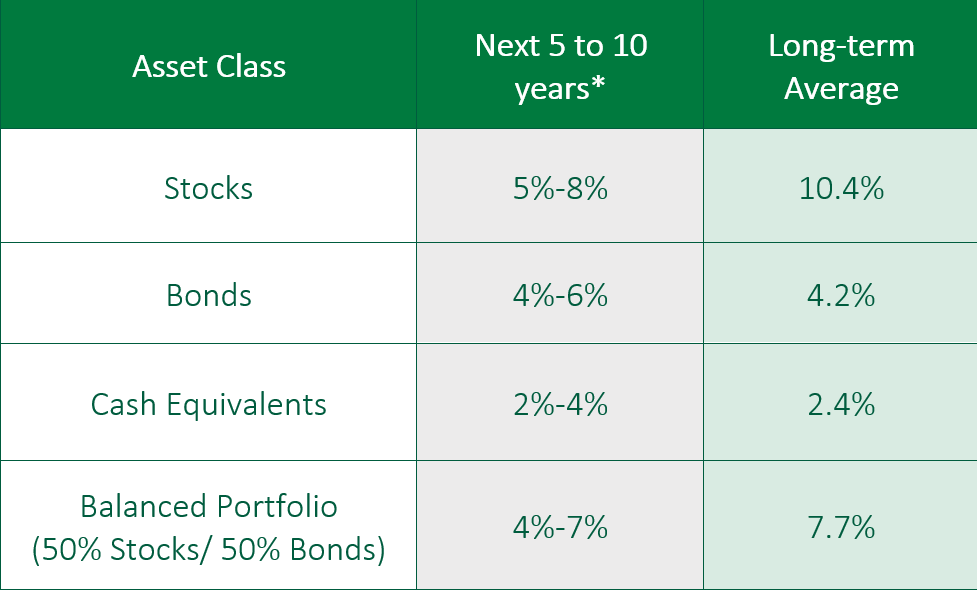 Figure 6
*Forecasted average annual returns of COUNTRY Trust Bank Wealth Management
Source: Morningstar and COUNTRY Trust Bank® - See Definitions and Important Information below
COUNTRY Trust Bank® Wealth Management Team
- Troy Frerichs, CFA - VP, Investment Services
- Jeff Hank, CFA, CFP® - Manager, Wealth Management
- G. Ryan Hypke, CFA, CFP® - Portfolio Manager
- Beau Lartz, ChFC® - Investment Analyst
- Cody Behrens, CFA, ChFC® - Investment Analyst
- Emily Meldrum, CPA - Investment Analyst
- Chelsie Moore, CFA, CFP® - Director, Wealth Management & Financial Planning
- Kent Anderson, CFA - Portfolio Manager
- Jonathan Strok, CFA - Portfolio Manager
- Michelle Beckler - Investment Analyst
- Samantha Reichert - Investment Analyst
Looking for help navigating your future?
Set up a meeting with your local rep to review your current policies and make sure they're up to date. We pulled together some less obvious reasons to adjust your coverage.
COUNTRY Financial® is a family of affiliated companies (collectively, COUNTRY) located in Bloomington, IL. Learn more about who we are.
NOT FDIC-INSURED
May lose value
No bank guarantee
All information is as of the report date unless otherwise noted.
This material is provided for informational purposes only and should not be used or construed as investment advice or a recommendation of any security, sector, or investment strategy. All views expressed and forward-looking information, including forecasts and estimates, are based on the information available at the time of writing, do not provide a complete analysis of every material fact, and may change based on market or other conditions. Statements of fact are from sources considered reliable, but no representation or warranty is made as to their completeness or accuracy. Unless otherwise noted, the analysis and opinions provided are those of the COUNTRY Trust Bank investment team identified above and not necessarily those of COUNTRY Trust Bank or its affiliates.
Diversification, asset allocation and rebalancing do not assure a profit or guarantee against loss. All market indexes are unmanaged, and returns do not include fees and expenses associated with investing in securities. It is not possible to invest directly in an index.
Investment management, retirement, trust and planning services provided by COUNTRY Trust Bank®.
Past performance does not guarantee future results. All investing involves risk, including risk of loss.
Definitions and Important Information
Figures 1,2,3,4,5: Data sourced from FactSet Research Systems Inc, a global provider of integrated financial information, analytical applications and services for the investment and corporate communities.
Figure 6: The long-term average return data comes from Morningstar and is based upon compound average annual returns for the period from 1996 through December 31, 2025. Stocks are represented by the S&P 500® Composite Index. Bonds are represented by the Bloomberg U.S. Aggregate Bond Index. Cash Equivalents are represented by the Bloomberg U.S. Treasury Bill 1-3 month Index. The “Balanced Portfolio” is representative of an investment of 50% stocks and 50% bonds rebalanced daily. Forecasted stock returns include small capitalization and international equities. Forecasted bond returns include investment-grade bonds as well as below-investment-grade bonds. These returns are for illustrative purposes and not indicative of actual portfolio performance. It is not possible to invest directly in an index.
Stocks of small-capitalization companies involve substantial risk. These stocks historically have experienced greater price volatility than stocks of larger companies, and they may be expected to do so in the future.
International investing involves risks not typically associated with domestic investing, including risks of adverse currency fluctuations, potential political and economic instability, different accounting standards, limited liquidity, and volatile prices.
Fixed income securities are subject to various risks, including changes in interest rates, credit quality, market valuations, liquidity, prepayments, early redemption, corporate events, tax ramifications and other factors. Debt securities typically decrease in value when interest rates rise. The risk is usually greater for longer-term debt securities. Investments in lower-rated and nonrated securities present a greater risk of loss.
The yield curve plots the interest rates of similar-quality bonds against their maturities. The most common yield curve plots the yields of U.S. Treasury securities for various maturities. An inverted yield curve occurs when short-term rates are higher than long-term rates.
The S&P 500® Index is an unmanaged index consisting of 500 large cap U.S. stocks. The index does not reflect investment management fees; brokerage commission and other expenses associated with investing in equity securities.
The S&P Midcap 400 is a stock market index published by Standard & Poor’s (S&P). It measures the performance of 400 mid-sized companies in the United States, providing a benchmark for this segment of the market. These companies typically have market capitalizations ranging from about $8 billion to $22.7 billion.
The S&P Small cap 600 is a stock market index published by Standard & Poor’s (S&P). It measures the performance of 600 small-sized companies in the United States, providing a benchmark for this segment of the market. These companies typically have market capitalizations ranging from about $1.2 billion to $8 billion.
The MSCI EAFE Index measures international equity performance. It comprises the MSCI country indexes capturing large and mid-cap equities across developed markets in Europe, Australasia, and the Far East, excluding the U.S. and Canada.
The MSCI ACWI ex USA IMI index is an equity index that tracks stocks from developed and emerging market countries outside the United States, covering large‑, mid‑, and small‑cap companies. It provides a broad view of international equity performance across all major non‑U.S. markets.
The Russell 2000® Index measures the performance of the small-cap segment of the U.S. equity universe. It includes approximately 2000 of the smallest securities based on a combination of their market cap and current index membership.
The Bloomberg Aggregate Bond Index, often referred to as “the Agg,” is a broad-based benchmark that measures the performance of the U.S. investment-grade bond market. It includes a wide range of fixed-income securities.
The Bloomberg Galaxy Bitcoin Index represents the performance of Bitcoin as a digital asset, tracking changes in its market price across major crypto trading venues.
The gold New York Spot ($/oz) tracks the price of physical gold. It reflects how the market values gold as a store of wealth and a safe‑haven asset.
The silver NYMEX (NYM $/oz) continuous futures contract measures the price of silver traded on the futures market. It captures silver’s role as both a precious metal and an industrial commodity.
Non-farm payrolls are collected by the U.S. Bureau of Labor Statistics (BLS) monthly through the establishment survey which provides information on employment, hours, and earnings of employees on non-farm payrolls.
GDP or Gross Domestic Product is the monetary value of all goods and services produced during a specified period. The figure is used as a barometer of an economy’s health including its size and growth rate. In the U.S., quarterly GDP figures are typically “annualized” meaning the quarterly growth is compounded for four quarters.
The price-to-earnings ratio is a valuation ratio which compares a company's current share price with its earnings per share (EPS). EPS is usually from the last four quarters (trailing P/E), but sometimes it can be derived from the estimates of earnings expected in the next four quarters (projected or forward P/E). The ratio is also sometimes known as "price multiple" or "earnings multiple."
The federal funds rate is the interest rate at which depository institutions (like banks and credit unions) lend reserve balances to other depository institutions overnight on an uncollateralized basis. This rate is a key tool of U.S. monetary policy, set by the Federal Open Market Committee (FOMC) of the Federal Reserve. Changes in the federal funds rate can influence various economic factors, including inflation, employment, and the rates on consumer loans and mortgages.
Yield to Maturity (YTM) represents the total rate of return an investor can expect from a bond if they hold it until maturity and reinvest all interest payments at the same rate. It’s expressed as an annual percentage.
Credit spreads measure the difference in yields between bonds with the same maturity but different credit quality.
CPI stands for Consumer Price Index. It measures the average change over time in the prices paid by urban consumers for a basket of goods and services—such as food, housing, transportation, and medical care. CPI is a key indicator used to assess inflation and the cost of living.
The Consumer Sentiment Index measures how optimistic or pessimistic consumers are about the economy and their personal financial situation. It’s based on surveys that assess attitudes toward current conditions and future expectations, including income, employment, and inflation. A higher index indicates greater consumer confidence, which can signal stronger spending and economic growth, while a lower index suggests caution and potential economic slowdown.
Standard deviation measures how spread out a series of data is from its average or mean. A higher standard deviation means a wider dispersion to the mean. Two standard deviations imply that 95% of data values fall within +/- 2 standard deviations assuming a normal bell-curve shape.